Monday, April 22, 2019

blog 6. well, this has been fun

Pre-TED

I was pretty proud of myself for starting on the script to the TED talk the day that it was assigned. It was unexpected because I was unconventionally motivated for a public speaking event. Either way, my script was basically done about three days before the presentation. Of course, then on the day right before (Wednesday), I decided I wanted to take my messagee in an entirely new direction...which then led me to rewrite about half of my script. I suppose you could say it was a pretty stressful 24 hours.

Post-TED

If you asked me how I think I did or how I felt during the presentation, I couldn't tell you. It went by so fast, and it's really all just a blur at this point. I've never been a natural at public speaking, so there were definitely things I had to consciously be careful of, such as speaking in a monotone voice, speaking too fast, or not maintaining eye contact.

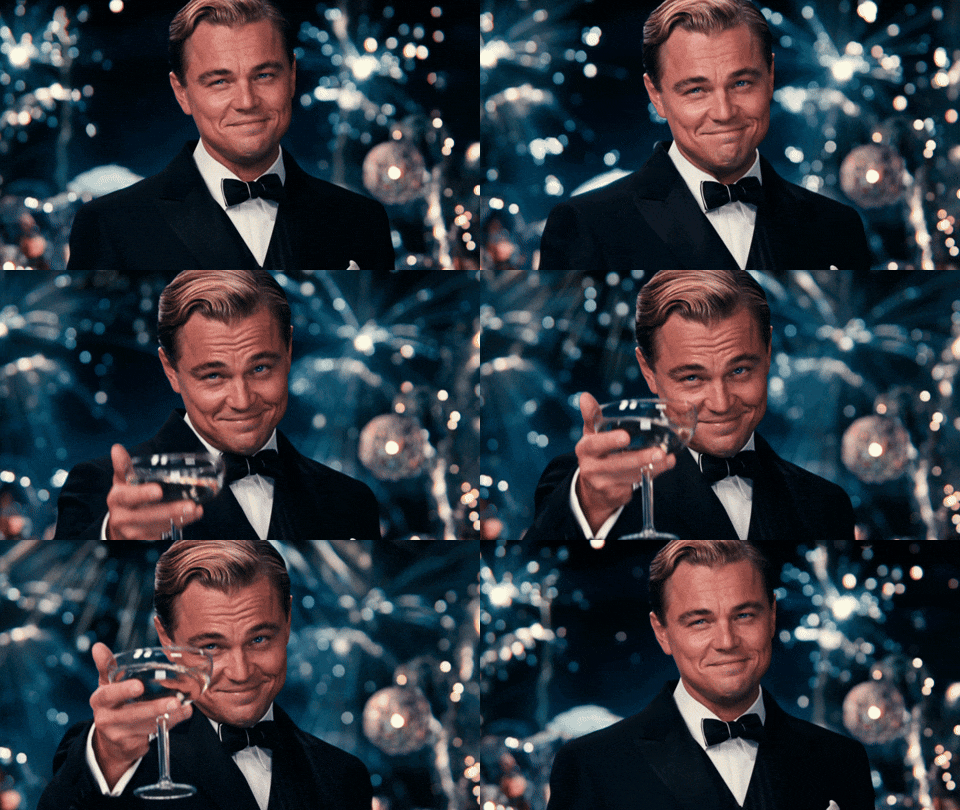
check out @mattsurelee on IG

I made it through without any major slips, which was a pretty great victory! It went smoothly, considering less than 24 hours prior I had neither a complete script nor a complete PPT. Also, both of my videos played (thank goodness!), despite my laptop connection having a long history of letting me down when I need it most. In any case, there were also ~more than a few~ things I could have done better. Here are the main things I would definitely fix if I did this again:

  1. In order to keep with the time, I focused decidedly less on my final product and more on the message. I didn't elaborate as much as I would have liked on that part of the presentation. In hindsight, I think this was also in part because my message had more to do with the process than the product. I wasn't the most successful in tying every aspect together.
  2. Anyone who has ever had a conversation with me would know that I tend to speak pretty fast. That, on top of nerves, equates to me talking at the speed of light during presentations. This is probably something I can only overcome through practice, so... good luck to me, I guess.
All of this being said, let's move on to the better part:

  1. When I mentioned earlier that I took a different approach to my TED talk, I meant it. My message was entirely different from the kinds of things I usually do, and it worked out well in the end. Especially for a project dealing with intrinsic motivation and positive messages, I think the honesty I tried to convey was really suitable.
  2. In reflecting on my own presentations, the first thing I consider is memorization. In this case, I'm happy with my familiarity with the script. Of course I had a few slips, but nothing I couldn't recover from. (yay! 👍) Most importantly, I tried to distinguish this kind of TED talk from other presentations like the Brain Project. This definitely had a certain level of informality, so memorizing the script contributed to the conversational-like tone.
And lastly, before I say good-bye to the Genius Project 2019, here is one last video I made of my trip to New York City over Spring Break.

It's just something small I made in about 15 minutes, so nothing too great to see here :)


- And so, it ends.


Sunday, April 7, 2019

blog 5. reflections on the product (part 2)

Today is April 7, which means it has been exactly 104 years since a woman named Eleanora Fagan was born in Philadelphia. You might know her better as Billie Holiday. Today also marks 155 years since the first camel race in Sacramento, California and 66 years since the unveiling of IBM's first commercial scientific computer. It's National Beer Day and National Girl, Me Too Day. Today we celebrate the birthdays of Russell Crowe and Jackie Chan, as well as Mr. W.K. Kellogg, without whom we would not have Poptarts, Froot Loops, or Rice Krispies.

Me contemplating life without Froot Loops (the best cereal)

Most importantly, however, April 7 means it has been exactly 53 days since the start of the Genius Project. That's right; we've arrived. Fifty-three days ago, at the start of the project, I had very high hopes for the final product. I had this great vision of how it would turn out and the steps I'd take to get there. It turns out things don't always happen as smoothly as the way you planned (shocker, I know). Video-editing, for instance, was a lot harder than I anticipated, and I ran into a lot more difficulties. So instead of focusing on the final trailer as a whole, I decided to approach it from various smaller angles. For example, in order to measure my success, I set two criteria independent of each other: music and transitions. This was done in lieu of judging the trailer as one cohesive film because as you'll see, I wasn't very successful on that front. Basically, I'll just be reflecting on my ability to incorporate transitions and music separately.

I'm generously rating this a 4.7 / 10

Music

I used three different scores for this: music from the original trailer, music from the recut, and Best Horror Music Ever! Even though I tried my best to align climaxes in the music with certain critical scenes, it definitely still sounds choppy and abrupt at times. The hardest part was trying to navigate different parts of the music relative to jump cuts. I had to calculate it down to the hundredth of a second in order to make everything match up precisely. It's pretty rough towards the end. Also, since I failed to establish a story line, the entire video seems extremely random. It was hard to distinguish where the musical climaxes should line up.

Transitions

I aimed to incorporate two different types of transitions into the trailer, a jump cut and fade-to-black. They're both pretty aptly named; a jump cut is when one scene suddenly jumps to the next, and a fade-to-black is when one scene fades to black before the next one appears. I managed to include both, however rough it may have turned out. I used a lot more jump cuts than I probably should have, which contributed to the sporadic nature of this "trailer." In fact, I wouldn't even call it a trailer at this point; it's more like a compilation of various clips that I edited while only considering technical aspects. Fade-to-black transitions are commonly used to create mystery by showing glimpses of high-intensity scenes. You'll see that I've attempted to copy this technique at the very end.

P.S - pre-TED thoughts
This week, I found my motivation rising again with the prospect of the TED talk. I actually started writing my script the day it was assigned, which is how you know I'm motivated. I generally despise these sorts of presentations, but strangely enough, I had a lot of decent ideas on the direction I wanted to go in. I guess it was about time anyways. See you on Thursday!

Videos used in recut:
https://www.youtube.com/watch?v=2f516ZLyC6U
https://www.youtube.com/watch?v=JYKpIr1lSG0
https://www.youtube.com/watch?v=ycoY201RTRo
https://www.youtube.com/watch?v=fKPK6c0mKE0

Sunday, March 24, 2019

blog 4. the Vlog (home stretch!)

Yes, we have arrived at the most dreaded part of this project: the Vlog. I have never enjoyed being on camera, and this was no exception. I apologize in advance if I seem awkward for being awkward. 

Anyway, I've done most of my editing up until this point on iMovie, but for the sake of not having to deal with moving large files, I just recorded and edited everything on my school laptop (you'll have to excuse the quality). With the publication of this video on the interwebs, I suppose I am now officially a YouTuber. I can even feel the warped sense of egotism setting in already. Don't worry, I promise I'll do my best to remain grounded and equal to all of you inferior mortals.

In any case, this vlog didn't turn out exactly as I planned. It seems that Movie Maker is a really low-quality video-editing platform (who?? knew???). I had originally wanted to put in clips I'd accumulated over the last few weeks of me in the actual editing process, but Movie Maker somehow managed to corrupt / ruin all of them. And I, as an inexperienced video-editor, did not save any copies. Great job, I'm just sO proud of myself.  Oh, well. You live and you learn.

I suppose that's enough stalling for now. Behold, Hannah's Genius Project Vlog (2018):


There's one more blog after this, in which I will be displaying my final progress and results. See you next week!


Wednesday, March 13, 2019

blog 3. horror conventions of Tangled's recut (part 1)

Welcome back! Given that we are now just about halfway through the entire project, I decided to further move things along and focus on a broader picture this week. Instead of choosing another specific element to study, I decided to research the general structure and conventions of a horror film, which will culminate in me attempting to imitate an existing recut of Disney's Tangled trailer. Tangled has long been one of my favorite Disney movies 9 (after Mulan, of course). In comparing the original and recut trailers, I found them to have the most polarizing differences, so I thought it'd be a good one to start off with. (see bottom of page)

Right off the bat, the opening scene for either trailer sets up the mood and purpose. The original begins with a montage of Flynn Rider cracking witty jokes, while the recut features a closeup of a lantern being lit on fire (pictured bottom right).


Horror films use close ups in order to restrict the viewer's vision in order to create intrigue. The close shot is most popularly used to achieve this, as illustrated by the recut opening scene. Similar angles are used on characters' faces, such as Mother Gothel (left).

The lantern scene is immediately followed by a slow fade transition to a glass door opening by itself against a dark backdrop of moonlight. A slow fade-to-black transition is commonly employed in horror films to increase suspense and mystery. The original trailer features exactly the opposite, using simple click transitions between various scenes of Flynn Rider's antics.

Looking at the two videos as a whole, the recut trailer is significantly darker in lighting than the original. The colors are either muted or tinted with black/blue, while the original is consistently brightly colored. Just take a look at the iconic Disney castle.


The pseudo black-and-white color scheme of the recut trailer is used throughout the entire trailer to mimic common lighting techniques used by film directors to elicit fear and dread.


The soundtrack to the two trailers are also drastically different. As I discussed in the last blog, volume, tempo, and key of the music play a critical role in determining the overall mood. In horror films, nonlinear sounds such as a baby crying or dissonant chords can set the audience on edge. In the recut Tangled trailer, the original score is replaced with an eerie song highlighted by intense buildups and sudden cuts. Children's voices are also common elements in horrors. Because they are generally considered paragons of innocence, bringing direct contrast to this perceived image can elicit subconscious feelings of discomfort, as per this scene in the recut trailer:


After completing this analysis, I took it upon myself to attempt to recreate the edits of the Tangled trailer. This will be a two week project, and I'll hopefully have a cohesive product by next cycle. I will also be documenting my process in the video blog, so stay tuned!


Original: https://www.youtube.com/watch?v=ycoY201RTRo
Recut: https://www.youtube.com/watch?v=30T0lHR5_eo

Research: 
https://scholarworks.wmich.edu/cgi/viewcontent.cgi?article=3943&context=honors_theses
Dreyer, Courtney. “Crafting Fear: The Horror Film Trailer.” Western Michigan University, 2018.

Fu, Xiangyi. “Horror Movie Aesthetics: How Color, Time, Space and Sound Elicit Fear in an Audience.” Northeastern University, 2016.

Tuesday, March 5, 2019

blog 2. music & mood

Believe it or not, we're already about a third of the way through this project...which means I really need to buckle down. I began my learning experience this week by watching some introductory tutorials on YouTube, but I quickly realized this was kind of a waste of time. They were extremely bland and static, and most of them were telling me things I could pretty much figure out on my own. I realized I didn't really need a tutorial-based video; I could just as well learn by actually doing. Upon this revelation, I decided to skip this step and just begin with the subject I had planned: music.

In any film, various scores of music stimulate the subconscious to instigate different emotions. For example, thriller and horror and films will often employ dissonant screeching sounds we unconsciously associate with animals in distress. A study conducted in 2010 by the University of California found that humans are more sensitive to nonlinear sounds, a characteristic exploited by film composers to unsettle the audience. In the 1960 film Psycho, the overextended use of brass and string instruments was designed to imitate noises of panic in nature.

Infrasound, sound waves that have a frequency below the human detection range, is also shown to be able induce high levels of fear and anxiety. This tactic was revealed to be used in the 2007 film, Paranormal Activity, where audience members reported "dizzying fear levels despite a lack of action onscreen." Given my planned final project of editing a normal video into a horror-type, there will be a big focus on the changes in dynamic and tempo.

To get a little practice in, I shot two versions of an aesthetics video. Both versions use the same clips, but the first utilizes a less upbeat soundtrack with a slower tempo.
** For better quality, I recommend not watching these videos on fullscreen.

Music & Mood v1


This song is a cover of Hozier's "Angel of Small Death and the Codeine Scene" by the band Seafret. It's written in the key of F# minor, which helps to create a darker, sadder sound as opposed to the brighter and cheerier sound of major chords. This particular cover also strips down most of the original instrumentals to the minimalist guitar score, making it a little more mellow.

Music & Mood v2


This second song is Semisonic's "Closing Time," written in the key of G major. It's upbeat and plays at a faster tempo, both of which contribute to establish a more lighthearted mood than the first. Even though the two videos are technically the same, the music can convey an entirely different feel.

This week was certainly a nice throwback to my piano and music theory days! My mini-projects actually turned out better than I expected, which I find to be really motivating especially given how  I'm feeling a little apprehensive overall about my final project. In any case, stay tuned for next week's subject!


Citations

Inspiration: Aesthetic: A Chain Video

Research:
Stewart, Helen. “How Do Film-Makers Manipulate Our Emotions with Music?” BBC Arts & Culture, BBC, 13 Sept. 2013. www.bbc.co.uk/arts/0/24083243.


Sunday, February 24, 2019

blog 1. previous experience = basically none

I began my extensive video editing journey when I was at the ripe young age of 11. My friends and I edited together a few clips of us dancing around the backyard over some cheesy song and called it a music video. Since that ~enlightening~ first experience, I have pursued this interest by editing approximately two subsequent videos, both of which were mandated by school assignments. Movie Maker has accompanied me thus far on my journey to becoming the next Emma Chamberlain, but it is here that I must say good-bye. I am absolutely devastated to leave it behind, but I suppose I can always just drown myself in a stack of pancakes.

Today, however, we look to the future. I am excited to announce the next chapter of my journey into the world of video-editing: iMovie. I'm sure you all know what it is (even if you're lame and have an Android), so I won't waste any time explaining the premise of it. After doing some research on the best editing programs for beginners, I found that iMovie satisfied most sites' criteria of accessibility, price (free), easy user interface, and a good range of features. By the end of the next five weeks, I should be able to incorporate basic video-editing techniques into the video blog. Ultimately, however, my goal is to recut a movie trailer into a different genre. In other words, I'm basically going to try to edit the music, lighting, and transitions to create a different mood.

Here's an example (it's actually pretty cool): Stephen King's "It" recut as a family film

At this point, this still feels like a rather ambitious goal, especially given my extremely limited experience. It's one of those things that could either turn out really cool or really tragic. Not gonna lie, I'm kind of just crossing my fingers and hoping I didn't overestimate my abilities.

P.S - Hopefully I'll be feeling a little less daunted by the next post.

Latest Post

blog 6. well, this has been fun

Pre-TED I was pretty proud of myself for starting on the script to the TED talk the day that it was assigned. It was unexpected because I ...